底层文件格式速查

这篇笔记整理了在做基因组注释与变异检测时,常见目录结构与底层文件格式的含义。
主要覆盖参考基因组构建(BWA 索引、功能注释)、Fastq 原始测序数据、以及 VCF 变异结果文件中的关键字段。

参考基因组

1
2
3
4
5
6
7
8
9
10
11
12
13
14
15
16
17
18
19
20
21
22
23
24
25
26
27
28
29
30
31
32
33
34
35
36
37
38
39
40
41
42
43
44
45
46
47
48
49
50
51
52
53
54
55
56
57
58
59
60
61
62
63
64
65
66
67
68
69
70
71
72
73
74
75
76
77
78
79
80
81
82
83
84
85
86
87
88
89
90
91
92
93
94
95
96
97
98
99
100
101
102
103
104
105
106
107
108
109
110
111
112
113
114
115
116
117
118
119
120
121
122
123
124
125
126
127
128
129
130
131
132
133
134
135
136
137
138
139
140
141
142
143
144
145
146
147
148
149
150
151
tree .../Sus_scrofa/Ensembl_V111/
.../Sus_scrofa/Ensembl_V111/
├── 01_Build_Genome_DB.sh
├── 02_raw
│   ├── Sus_scrofa.Sscrofa11.1.111.gff3
│   └── Sus_scrofa.Sscrofa11.1.dna_sm.toplevel.fa
├── 03_genome
│   ├── cds.fa.gz
│   ├── gene.fa.gz
│   ├── genome.dict
│   ├── genome.fa
│   ├── genome.fa.amb
│   ├── genome.fa.ann
│   ├── genome.fa.bwt
│   ├── genome.fa.fai
│   ├── genome.fa.index
│   ├── genome.fa.pac
│   ├── genome.fa.sa
│   ├── genome.gff
│   ├── mrna.fa.gz
│   ├── pep.fa.gz
│   ├── promoter_3kb.fa.gz
│   ├── Ref
│   │   ├── genome.fa
│   │   ├── id_table.txt
│   │   ├── ref.genome.dict
│   │   ├── ref.genome.fa
│   │   ├── ref.genome.fa.amb
│   │   ├── ref.genome.fa.ann
│   │   ├── ref.genome.fa.bwt
│   │   ├── ref.genome.fa.fai
│   │   ├── ref.genome.fa.len
│   │   ├── ref.genome.fa.pac
│   │   ├── ref.genome.fa.sa
│   │   └── ref.genome.gff
│   └── stat
│       ├── biological_region
│       │   └── table_per_feature_type.txt
│       ├── gene@c_gene_segment
│       │   ├── name
│       │   │   └── name_exon.txt
│       │   └── table_per_feature_type.txt
│       ├── gene@j_gene_segment
│       │   ├── name
│       │   │   └── name_exon.txt
│       │   └── table_per_feature_type.txt
│       ├── gene@mrna
│       │   ├── description
│       │   │   └── description_gene.txt
│       │   ├── name
│       │   │   ├── name_exon.txt
│       │   │   ├── name_gene.txt
│       │   │   └── name_mrna.txt
│       │   └── table_per_feature_type.txt
│       ├── gene@rna
│       │   ├── name
│       │   │   ├── name_exon.txt
│       │   │   ├── name_gene.txt
│       │   │   └── name_rna.txt
│       │   └── table_per_feature_type.txt
│       ├── gene@v_gene_segment
│       │   ├── description
│       │   │   └── description_gene.txt
│       │   ├── name
│       │   │   ├── name_exon.txt
│       │   │   ├── name_gene.txt
│       │   │   └── name_v_gene_segment.txt
│       │   └── table_per_feature_type.txt
│       ├── ncrna_gene@lnc_rna
│       │   ├── description
│       │   │   └── description_ncrna_gene.txt
│       │   ├── name
│       │   │   ├── name_exon.txt
│       │   │   ├── name_lnc_rna.txt
│       │   │   └── name_ncrna_gene.txt
│       │   └── table_per_feature_type.txt
│       ├── ncrna_gene@mirna
│       │   ├── description
│       │   │   └── description_ncrna_gene.txt
│       │   ├── name
│       │   │   ├── name_exon.txt
│       │   │   ├── name_mirna.txt
│       │   │   └── name_ncrna_gene.txt
│       │   └── table_per_feature_type.txt
│       ├── ncrna_gene@rrna
│       │   ├── description
│       │   │   └── description_ncrna_gene.txt
│       │   ├── name
│       │   │   ├── name_exon.txt
│       │   │   ├── name_ncrna_gene.txt
│       │   │   └── name_rrna.txt
│       │   └── table_per_feature_type.txt
│       ├── ncrna_gene@scrna
│       │   ├── description
│       │   │   └── description_ncrna_gene.txt
│       │   ├── name
│       │   │   ├── name_exon.txt
│       │   │   ├── name_ncrna_gene.txt
│       │   │   └── name_scrna.txt
│       │   └── table_per_feature_type.txt
│       ├── ncrna_gene@snorna
│       │   ├── description
│       │   │   └── description_ncrna_gene.txt
│       │   ├── name
│       │   │   ├── name_exon.txt
│       │   │   ├── name_ncrna_gene.txt
│       │   │   └── name_snorna.txt
│       │   └── table_per_feature_type.txt
│       ├── ncrna_gene@snrna
│       │   ├── description
│       │   │   └── description_ncrna_gene.txt
│       │   ├── name
│       │   │   ├── name_exon.txt
│       │   │   ├── name_ncrna_gene.txt
│       │   │   └── name_snrna.txt
│       │   └── table_per_feature_type.txt
│       ├── ncrna_gene@transcript
│       │   ├── description
│       │   │   └── description_ncrna_gene.txt
│       │   ├── name
│       │   │   ├── name_exon.txt
│       │   │   ├── name_ncrna_gene.txt
│       │   │   └── name_transcript.txt
│       │   └── table_per_feature_type.txt
│       ├── ncrna_gene@trna
│       │   ├── name
│       │   │   └── name_exon.txt
│       │   └── table_per_feature_type.txt
│       ├── pseudogene@pseudogenic_transcript
│       │   ├── description
│       │   │   └── description_pseudogene.txt
│       │   ├── name
│       │   │   ├── name_exon.txt
│       │   │   ├── name_pseudogene.txt
│       │   │   └── name_pseudogenic_transcript.txt
│       │   └── table_per_feature_type.txt
│       ├── region
│       │   └── table_per_feature_type.txt
│       └── stat_features.txt
├── 04_diamond
│   ├── cds.diamond_blastx.go.txt
│   ├── cds.diamond_blastx.kegg.txt
│   ├── cds.diamond_blastx.nr.txt
│   ├── mRNA2gene.txt
│   └── tmp
├── 05_annotation
│   ├── GO.annotation.txt
│   ├── KEGG.annotation.txt
│   └── NR.annotation.txt
└── nohup.out

  • 01_Build_Genome_DB.sh: 核心构建脚本。包含从原始数据下载、过滤、索引构建到功能提取的全流程命令。
  • nohup.out: 记录脚本运行过程中的标准输出与错误日志,用于追溯构建过程中的异常。
  • 02_raw: 存储从公共数据库(如 Ensembl)下载的原始未处理文件。
    • .gff3: 原始基因组注释。
    • .dna_sm.toplevel.fa: 软掩盖(Soft-masked)的基因组序列,重复序列被标记为小写字母。
  • 03_genome:存储处理后的序列及各类访问索引。
    • *.fa.gz (cds, gene, mrna, pep, promoter): 提取出的各类功能元件序列包。
    • genome.fa / genome.gff: 经过标准化处理(如重命名染色体)的主参考文件。
    • BWA 索引 (.amb, .ann, .bwt, .pac, .sa): 用于二代测序数据比对。
    • 访问索引 (.fai, .dict): 用于随机定位与校验。
    • Ref/
      • ref.genome.*: 该子目录下文件通常为 downstream 流程(如 GATK)专用。
      • id_table.txt: 关键对照表,记录原始染色体 ID 到标准化 ID 的映射。
    • stat/
      • gene@mrna/ / ncrna_gene@lnc_rna/ 等: 按“父特征@子特征”命名的分类统计。
        • name/: 包含 ID 与基因/转录本名称的映射(name_gene.txt 等)。
        • description/: 存储基因的功能描述信息,用于注释补全。
        • table_per_feature_type.txt: 该类特征的数量、平均长度等统计报表。
      • stat_features.txt: 整个基因组所有特征类型的总览统计。
  • 04_diamond:使用 DIAMOND 工具将提取的 CDS/mRNA 序列与蛋白库进行比对。
      • *.go.txt / *.kegg.txt / *.nr.txt: 初始比对结果,记录了查询序列与数据库序列的相似性得分(E-value, Identity)。
    • mRNA2gene.txt: 关系映射表,用于将比对到的转录本功能归类到所属基因上。
  • 05_annotation:将比对结果经过滤、去重、权重筛选后生成的最终注释表。
    • GO.annotation.txt: 基因与 Gene Ontology 词条的对应关系。
    • KEGG.annotation.txt: 基因与代谢通路(Pathways)的对应关系。
    • NR.annotation.txt: 基因与已知蛋白功能的详细文本描述对照表。

序列访问索引

这类索引用于实现对大型 FASTA 文件的随机访问(Random Access),使软件能够快速定位并提取特定染色体或位置的碱基。

genome.fa.fai
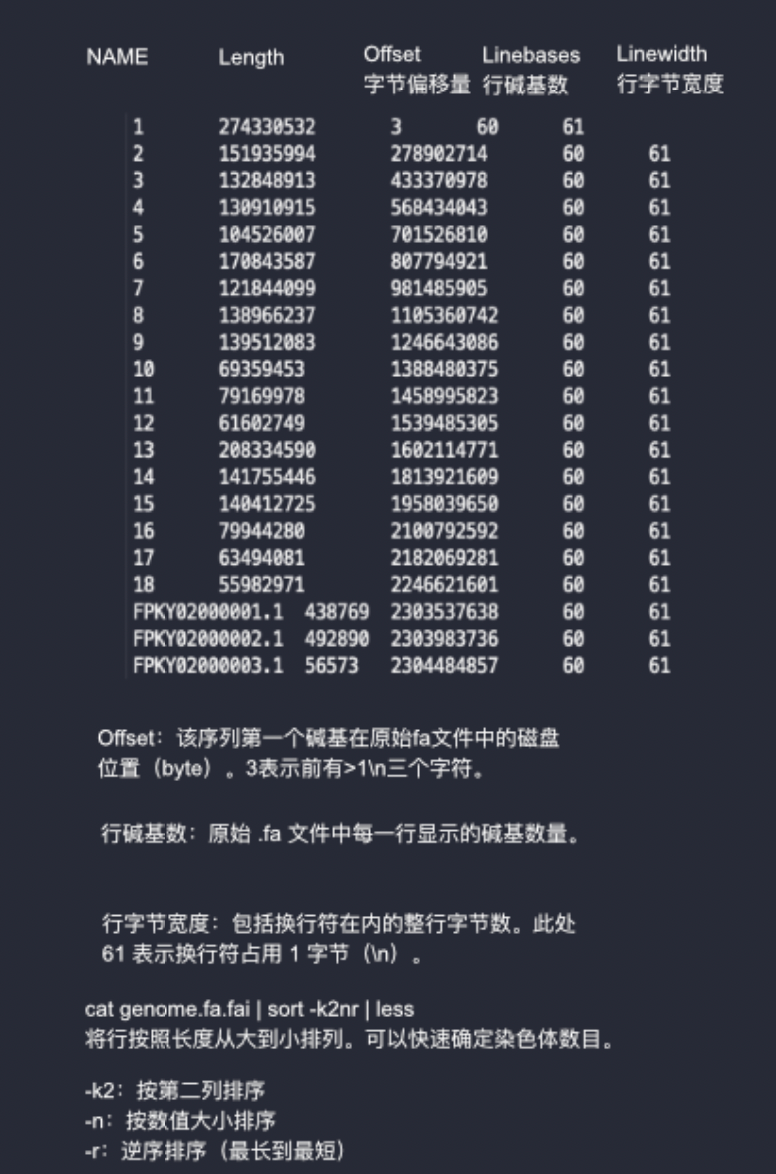
genome.fa.fai 示例 注:某些性染色体(如 Y 染色体)或部分高度重复区域的组装结果可能比某些长 Scaffold 还要短。仅凭长度排序是一种启发式搜索,不能作为最终证据。建议结合第一列的 NAME 命名规范进行二次判定。

基于BWA的比对索引

| 扩展名 | 格式/内容解释 | | — | — | | .bwt | Burrows-Wheeler Transform:核心索引,将序列转换为数学表示。 | | .ann | Annotation:记录染色体 ID、长度及在 .pac 中的连接顺序。 | | .amb | Ambiguous:记录非 ATGC 碱基(如 N)的位置。 | | .pac | Packed:二进制。将原始碱基以 2-bit 形式压缩存储。 | | .sa | Suffix Array:后缀数组采样点,用于坐标还原。 |

测序原始文件
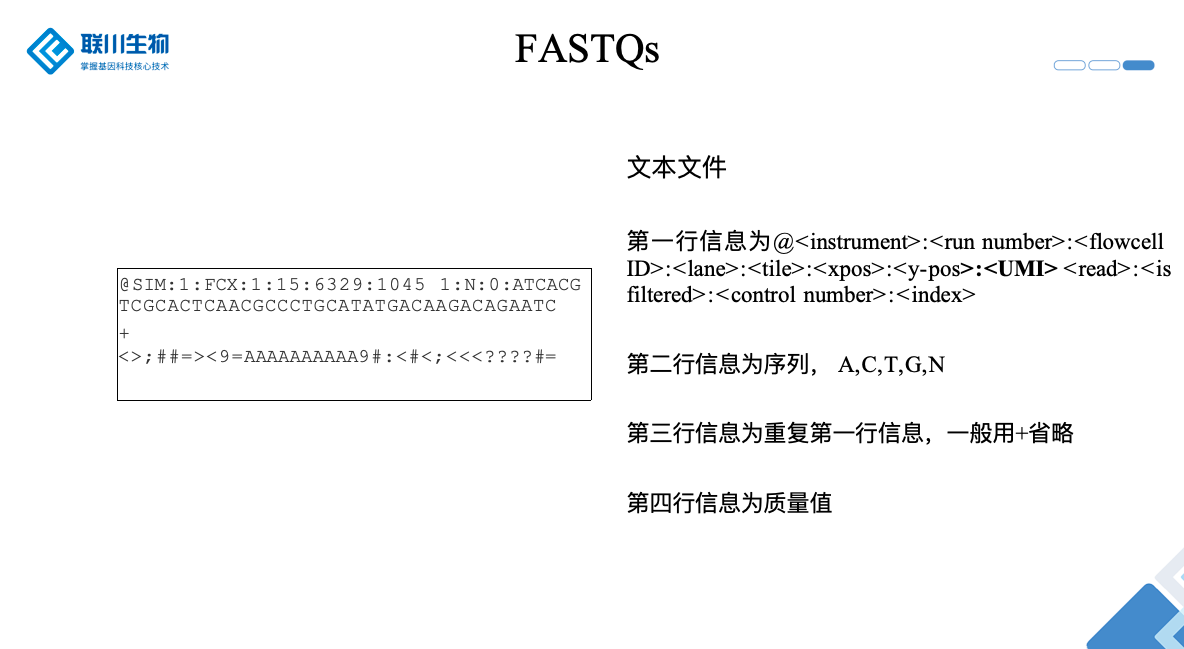
Fastq 结构示意

Variant calling结果文件

VCF

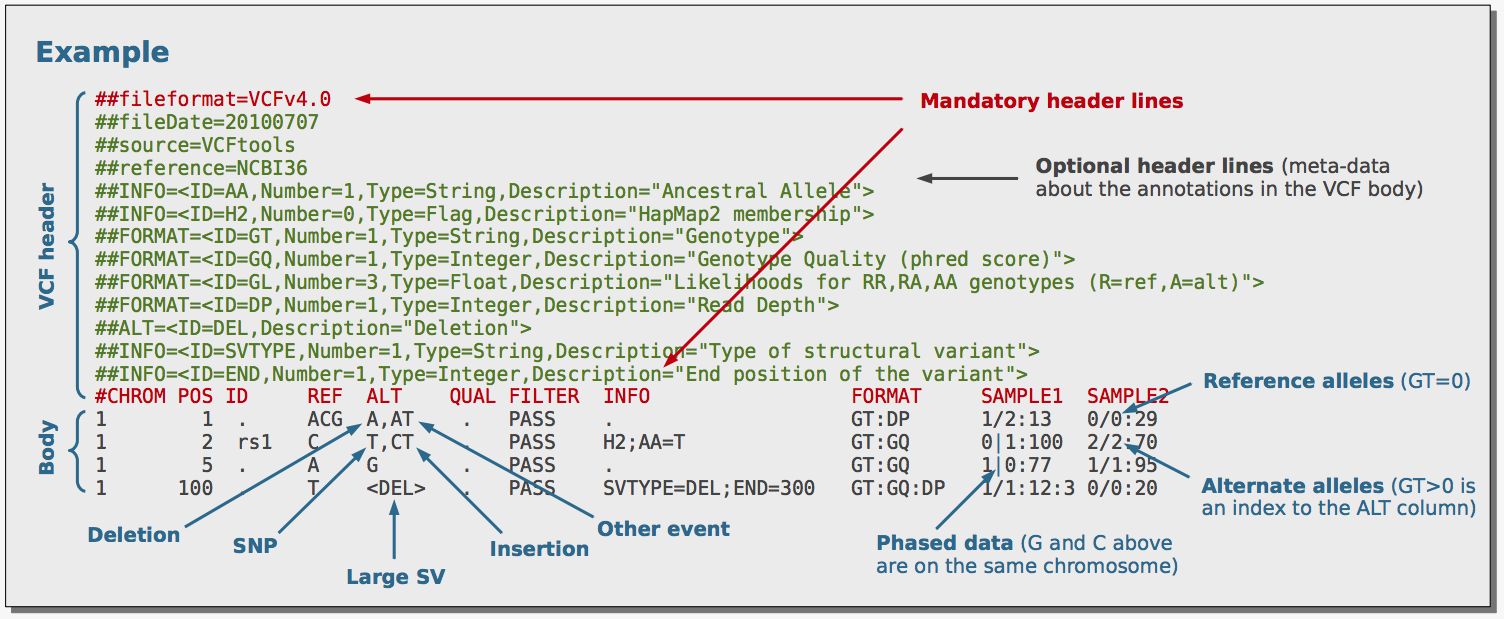
VCF 字段示意

字段名 格式/内容解释
CHROM 变异所在的染色体 ID(如“1”、“chrX”)
POS 变异在染色体上的物理位置(从 1 开始,单位为 bp)
ID 变异的唯一标识符(如 dbSNP 编号“rsID”;若无则为“.”)
REF 参考基因组的碱基(或序列),即未发生变异时的等位基因
ALT 变异等位基因(Alternative),与 REF 不同的碱基(或序列);多等位用逗号分隔
QUAL 变异位点的质量分数(Phred Scale),表示对该变异存在的置信度,值越高越可靠
FILTER 过滤结果,“PASS” 表示通过所有标准,其他为未通过的过滤标签或原因
INFO 逗号分隔的附加注释信息,如变异类型(SNP/INDEL)、功能注释、等位基因频率、深度等参数;具体内容取决于分析流程
FORMAT 后续样本信息格式。描述每个样本的字段顺序与类型(如 GT:DP 表示基型和测序深度)
SAMPLE1 按 FORMAT 顺序展示该样本的各项指标(如“0/1:26”,分别表示基因型0/1和深度26)
SAMPLE2 同上,代表下一个样本的数据

从“变异检测(Calling)”到“质量过滤(Filtering)”再到“功能注释(Annotation)”,每个阶段产生的 VCF,其 INFO 列的侧重点存在显著的诊断性差异。

原始检测阶段 (Raw Variant Calling)

目标:评估变异信号是否真实存在,排查测序噪声(Artifacts)。

产生的 VCF:单样本 VCF 或 gVCF(Genomic VCF)。

INFO 核心关注点:测序深度分布、碱基质量偏差、链偏好性。

联合分型与群体评估阶段 (Joint Calling & Population Stats)

目标:在群体层面评估等位基因频率,通过群体特征修正个体位点的置信度。

产生的 VCF:多样本(Multisample)VCF。

INFO 核心关注点:等位基因计数(AC)、频率(AF)、群体层面的质量指标。

功能过滤与临床/育种注释阶段 (Filtering & Annotation)

目标:判定变异的生物学效应及其与表型的关联。

产生的 VCF:过滤后的 VCF、注释后的 VCF(Annotated VCF)。

INFO 核心关注点:基因组位置(内含子/外显子)、氨基酸改变、有害性预测分值。


具体字段的理解

  • QUAL 为 . 是什么意思?
    • QUAL 是位点层面的质量值(Phred),但在不少场景会缺失并写成 .,常见原因包括:
      • 该 VCF 来自联合分型/二次处理流程,作者选择不输出无法定义统一的 site-level QUAL;
      • 该记录不是标准“变异位点”的评分(例如某些 gVCF 的非变异记录/中间格式转换)。
    • 实战中更常用的是 FILTERINFO(如 QD/FS/MQ)和样本级 FORMAT(如 GQ/DP/AD/PL)综合判断。
  • INFO 字段分类解析

    • 测序与比对质量指标(用于 Hard Filtering) 这些指标是区分真实变异与测序/比对误差的关键诊断依据。
字段 全称 诊断意义(贝叶斯视角下的排他性证据)
QD QualByDepth 变异置信度与深度的比值。若 QD 过低,说明高质量碱基支撑不足,可能是由重复序列区域的比对错误引起的。
FS FisherStrand Fisher 链偏好性评分。若值过高(>60),说明变异仅出现在正向链或反向链中,高度疑似测序偏好造成的假阳性。
SOR StrandOddsRatio 另一种衡量链偏好性的指标,尤其在深度较高时比 FS 更稳健。
MQ RMSMappingQuality 比对质量均方根。若 MQ < 40,说明支持该变异的 Read 大多来自比对不明确的区域(如转座子、重复序列)。
MQRankSum MQ Rank Sum 比较参考基因组 Read 与变异 Read 的比对质量差异。若差异显著,说明变异 Read 可能源自错配。
1
2
- 群体遗传学指标(用于群体研究/GWAS)
当样本量增加时,这些指标可作为评估位点多态性的证据。
字段 全称 说明
AC Allele Count 该位点 ALT(变异)等位基因在当前群体中出现的总次数。
AN Allele Number 该位点所有有效样本(非缺失)中等位基因的总数(二倍体通常为 2× 样本数)。
AF Allele Frequency 等位基因频率 (AF=AC/AN)。在罕见疾病分析中,AF > 1% 通常被视为中性变异的排除证据。
1
2
3
4
5
6
7
- 功能注释指标(由 SnpEff/VEP 等工具添加)
这是将技术数据转化为业务结论的关键字段。 | 字段        | 说明                            | 示例内容                                                                                   | |-------------|---------------------------------|--------------------------------------------------------------------------------------------| | ANN / CSQ   | 功能预测 (Consequence)          | 记录变异对蛋白质的影响:missense_variant (错义), synonymous_variant (同义), stop_gained (提前终止)。 | | LOF         | 功能缺失 (Loss of Function)     | 标识变异是否导致基因功能丧失。在育种中,这是筛选关键控制基因的核心证据。                   | | NMD         | 无义介导降解                    | 预测转录本是否会因为提前终止密码子而被细胞机制降解。                                       |

- 特殊格式:gVCF 里的 INFO 差异
如果运行的是 `HaplotypeCaller` 的 `-ERC GVCF` 模式,
	- END 字段:由于 gVCF 会记录“非变异区域(Non-variant blocks)”,END 表示该块状区域(Block)的结束位置。
	- 逻辑变化:在 gVCF 阶段,INFO 并不提供复杂的变异指标,而是记录该区域作为“纯合参考”的置信度。这是为了在后续多样本 GenotypeGVCFs 阶段提供先验概率。
  • FORMAT 常见会有哪些字段?怎么和每个 SAMPLE 对上?
    • FORMAT 用冒号把“样本列里每一段的含义”写清楚,样本列按同样的冒号顺序给出值。
    • 常见 FORMAT 子字段(不同 caller/流程会略有差异):
      • GT:基因型(genotype),最关键。
      • DP:该样本在该位点的测序深度(depth)。
      • AD:allelic depth,常见为 REF,ALT1,ALT2... 的计数,例如 AD=10,3 表示 REF 支持 10、ALT1 支持 3。
      • GQ:genotype quality(Phred),表示该样本基因型判定的置信度。
      • PL:phred-scaled likelihoods,基因型似然(通常是一串逗号分隔的整数,用于下游再推断)。
      • PS:phase set(相位集合 ID),配合 GT 中的 | 使用(不是所有 VCF 都有)。
    • 例子:若 FORMAT=GT:AD:DP:GQ,则样本列形如 0/1:10,3:13:45,逐段对应 GT=0/1AD=10,3DP=13GQ=45
  • GT 里的 1/20|11|01|1 怎么读?
    • GT 的数字是对 REF/ALT索引编号
      • 0 表示 REF
      • 1 表示 ALT 列里第 1 个等位基因
      • 2 表示 ALT 列里第 2 个等位基因(如果 ALT 是多等位,比如 ALT=AT,CT
    • ` / ` vs ` `:
      • 0/1未定相(unphased)的杂合,表示两个染色体拷贝分别为 REF 和 ALT1,但不知道哪条单倍型上是哪一个。
      • 0|1已定相(phased),表示这两份等位基因的相位已知(哪条单倍型是 0,哪条是 1)。
    • 常见组合的直觉:
      • 0/0:纯合参考(无变异)。
      • 0/1:杂合(一个 REF、一个 ALT1)。
      • 1/1:纯合 ALT1(两个拷贝都是第 1 个 ALT)。
      • 1/2多等位杂合(一个拷贝是 ALT1、另一个拷贝是 ALT2;要求 ALT 至少有两个备选等位基因)。
      • 0|1 vs 1|0:两者都表示杂合且已定相,但哪条单倍型携带 ALT 不同;如果下游做连锁/单倍型分析,这个方向信息会影响结果。